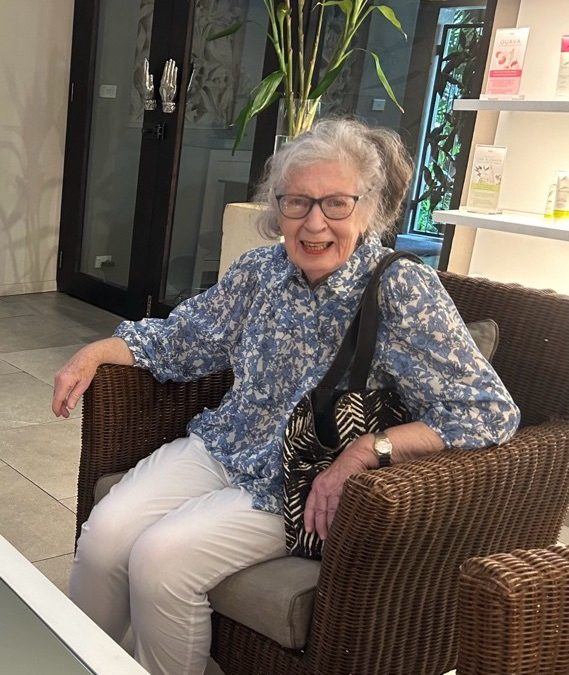
MARY JOHNSON (1945 – 2025)
Our collective tribute to Mary, submitted to the print version of MESSAGES. was necessarily compressed to fit many views into a limited space. My memories certainly include all of those fine traits of her character that we captured. I add a few personal anecdotes, highlighting her humourous and lighter side.
Her sense of humour was outstanding. Our times together were always full of laughter, and Mary invariably found the practical, positive and sunny side of situations, even when they were serious. On one occasion, when we were working together in Fiji, I was on mission in Tuvalu and stranded there for several weeks due to airline fuel problems. Communications were almost impossible. Mary miraculously found a satellite phone connection to my hotel. It was early November. She announced gaily that she had good news: a boat would be coming through in a few weeks and she could get me back to Suva by Christmas. We both laughed (I, hesitantly), before she assured me that she would keep looking for solutions. A few days later, another call. She said an official New Zealand delegation would visit Tuvalu the next day on a private plane with enough fuel to leave the island. She told me to get out on the runway and “show a little knee” to the High Commissioner to secure a place on the plane. I obeyed and got on the flight.
We have cited Mary’s broad range of interests in the arts, literature, archeology, history and politics. She also had a fine ear for music and was particularly fond of Schubert. And she could sing. On one of our vacations together after retirement, we were on a small boat on a tributary of the Mekong River. One of the boatmen was rowing standing up. I mentioned that in Italy the gondola rowers would often sing. So, the young boatman sang us a song. Mary reciprocated by clearly and loudly singing Santa Lucia, acapella. It was pure delight.
Mary’s painting and drawing talents were put to good use one day in Fiji. Despite repeated pleas for funds to buy a fax machine, the Regional Office refused our requests. We bought a large tapa cloth (wood bark) and Mary painted our request in pidgin Fijian/English. We all signed with Fijian names. We rolled up the tapa cloth and sent it by UNDP pouch to the Regional Office. The funds were approved the following week.
I should add that Mary’s wide knowledge also included the finest tapestries, the best materials for home decorations, qualities of ceramics, the right choice of tiles for floors or walls, and of course much valued advice on cooking. I benefited from all of this and from words of advice countless times.
Mary was an exceptional colleague and a marvelous friend. I miss her. Her absence will be deeply felt for a long time.
Sally Christine Cornwell
November 2025
Mary Johnson 1945 – 2025
The news of Mary’s passing on 1 July 2025 came as a profound shock.
Mary was always a kind and loyal friend—our friendship began the moment we arrived in Suva in 1987 to take up a JPO post in the ILO office. From the very start, she looked after us, and we soon found ourselves living in a house just opposite hers. She hosted countless dinner parties, serving healthy and often local dishes, and they were always filled with laughter and warmth. Her delightful sense of humour brightened the challenging post-coup times in Fiji. Having spent her childhood there, Mary understood Fiji deeply and guided us through the sometimes incomprehensible Pacific politics and customs. She was endlessly generous to anyone who needed support. When I required a medical evacuation to Sydney during my pregnancy with our eldest son in 1988, she immediately arranged for the entire Johnson family to care for me. We remain profoundly grateful to her—and to the Johnsons—for their kindness. Even as life took us to different parts of the world, our friendship endured.
During one of her post-retirement visits to Turin and Geneva, we began talking about a possible Fiji reunion trip. After much planning and many conversations, the trip finally took place in May 2024. Mary shared countless stories from her youth in Fiji—stories we had never heard before. We celebrated her 79th birthday with champagne somewhere along the Coral Coast, a moment we will never forget.
We feel incredibly fortunate that we were able to make the Fiji trip happen. It made us even more aware of how rare and special a friendship of more than 35 years truly is, especially when lived across different continents. We miss her cheerful, kind, and humorous presence dearly. The world is not the same without Mary.
Alette van Leur and Sjoerd Draaisma
November 2025
Remembering Mary Johnson at the ITCILO
Mary Johnson started her career at the United Nations in 1972, when she was hired by the International Centre for Advanced Technical and Vocational Training, a training institution part of the International Labour Organization (ILO) based in Turin, Italy. From 1972 until 1980 she worked in the Research and Studies, Finance and Programme, and External Relations Departments, developing her competencies in an enriching international environment, considering that the Centre is visited every year by thousands of participants from the 187 ILO’s member States. In 1981 Mary was promoted from the General Service to the Professional category and continued to develop a brilliant career in the Centre’s Programme Promotion Office, where she worked until 1987.
In 1987 she was sent on secondment to the ILO Suva Office, as Responsible for financial and administrative operations, where she served until 1989. In 1990 she returned to the Centre, that meantime was renamed to International Training Centre of the ILO (ITC ILO), as Project Officer for Asia and Pacific. In 1992 she was promoted Coordinator of the Promotional Activities, responsibility that she holds until 1994 when she was transferred to ILO Geneva.
Mary’s hard work, commitment and competence were determinant for the development of effective fund-raising activities to support the development and financial stability of the ITC ILO, that from few thousands of participants in the first decades was in last years, receiving more than ten thousand participants to its courses.
In addition to the professional activities for the Centre, Mary has been highly appreciated for her availability to help, guide and support colleagues, and for several years in the eighties she was elected as Chairperson of the Centre’s Staff Union. Under her brilliant leadership the Staff Union became stronger and was able to obtain substantial improvements in the working conditions, job security, career development, equal opportunities and alignment to the ILO’s Human Resources policies.
In Turin, Mary was a role model for many colleagues. Always determined, yet generous, positive, and empathetic, she will never be forgotten.
Valeria Morra
November 2025
A Tribute to Mary Johnson
I remember Mary well as a wonderful human being, a great boss, and a true friend. As Head of Programme at ROAP, she was always there for me, giving guidance and sound advice when I was the fellowship officer at the regional office responsible for all fellowship training in Asia and the Pacific, as well as identifying candidates from the region to attend courses in Turin.
One unforgettable experience was when she organized for me to attend a seminar for all ILO Fellowship Officers in Turin. I had the opportunity to stay at the Centre, meet fellowship officers from all over the world, and share our experiences.
On a personal note, we shared the same interests in the arts. Our painting lessons took us to different locations in Thailand, even to the seaside in Hua Hin. After she left Bangkok, we always met whenever she passed through during her hectic schedule.
Mary worked hard and served in many important positions in the ILO. Even after retirement, she continued to represent our region in several committees in Geneva.
I am deeply saddened to hear of Mary’s passing. May her beautiful soul rest in peace.
Suvimol Poshyanonda – November 2025
Remembering Mary
I first got to know Mary during the time both of us were based in Bangkok in the late 1990s, and we were friends ever since. While we didn’t work together, she was a marvellous neighbour and colleague, very hospitable and outgoing. I really enjoyed having delicious meals over great conversations in her house. She always managed to describe events in her life in a way that turned them into memorable, entertaining stories, an ability I wish I had! She was a talented artist – she made time for drawing and painting, her favourite pastimes, even though she was under time-pressure at work, and devoted herself to developing her talent in landscape and still life painting after she retired, displaying her work in several group exhibitions. I treasure the paintings of hers that I have, reminding me of her regularly.
One of her artistic ideas stands out in my memory. When we were on a remote island in Thailand in 2004, she came up with the idea of collecting the random flip-flops or thongs that washed up on the beach, so as to make a model of a tsunami that she would enter in a Bondi Beach exhibition, as a sarcastic comment on what some politicians were saying about immigrants they referred to as ‘thongs’. She commissioned local children to continue collecting the flip-flops after she left for home, and these were to be sent to her when the rainy season ended. She went as far as commissioning an engineer acquaintance to design a model tsunami for her. So she had people on the island talking about giant waves in the months before the actual tsunami hit in December 2004. She dropped the idea, though the collected flip flops stayed around for a good while afterwards. People asked ‘How did she know, did she have a foreboding?
Mary has left us, leaving a gap that is hard to fill. Strong memories remain and will continue to inspire me as time passes. My deepest condolences to Franco and Stefano.
Barbara Murray
November 2025
Remembering Mary
Mary retired from the ILO in 2002 (2003?). She took a break for a few months of art school and art history in Florence before returning to Sydney where her son, Stefano, was living. She had earlier purchased a beautiful apartment on a ridge overlooking the city and close to the harbour, where she gave lunch and dinner parties on a terrace looking as if it had flown in from Italy for the day.
In Sydney, Mary had many friends from her university days, when she had studied Italian and archaeology, as well as from her earlier period as a boarder at Frensham, a non-religious school for girls situated in the southern highlands of New South Wales, with an ethic of service to others; clearly a fitting choice of school for Mary. She travelled annually to Europe, mainly to Geneva and Turin where her husband, Franco, lived, as well as making frequent trips to Fiji. Mary painted prolifically and, with a group of fellow women artists, exhibited from time to time including one grand exhibition at the Bondi Beach Pavilion. Her works were mainly of still life, with a penchant for flowers and nature, though her academic interest was in the work of the Italian masters, led perhaps by Caravaggio. This interest mirrored another, chamber music, again particularly from the baroque period.
Mary’s principal passion back in Australia was promoting the UN system and more particularly, ensuring the well-being of retirees. She became President of AAFICS (Australian Association of Former International Civil Servants) in 2006 and in some 12 years changed an informal luncheon club into a formal organisation with regional co-ordinators, a newsletter, regular meetings, and a system for aiding members who were having difficulties in their dealings with the Pension Fund or After Service Health Insurance systems. Mary herself would phone these secretariats and prosecute the case of a distressed retiree or get legal advice from retired legal advisers and send it on to the Fund to prompt appropriate action. She assiduously followed UN Pension Fund policy issues and attended FAFICS (Federation of the Associations of Former International Civil Servants) meetings on-line and occasionally in person, and was for a period, a FAFICS representative on the Pension Board. Mary was also largely responsible for associating AAFICS with a legal challenge by an Australian retiree from the World Bank over the taxation by the Australian Government of World Bank pension payments. This case went on appeal to the High Court but there the ruling was that these pension payments were not ‘salary and emoluments’ and were not received direct from the employing organisation and thus were not immune from national taxation under international law. The same principles applied in relation to UNJSPF pensions.
Mary read voraciously, particularly on history and archaeology, and could converse on almost any subject with ease and charm, which talent, along with her contagious laughter, made her a most delightful companion. As in her youth, Mary had no hesitation in following her conscience to join protests and public demonstrations when issues of social justice or world peace were at stake.
Kelvin Widdows
November 2025
Memories of Mary Johnson
I first met Mary when I started working in the Regional Programming Section (RPS) in the Regional Office for Asia and Pacific (ROAP) in Bangkok in May 1998; Mary was heading the unit at the time. Having transferred directly from the Country Office in Beijing, I was ready to get to know the inner workings of the Regional Office and of course experience life in Bangkok to the fullest. Mary was a brilliant teacher on both levels. At the working level, her approach was to involve everyone as much as possible, while at the same time expecting everyone to learn on the job and assume responsibility for one’s area of work. I always admired her for her calmness even in the most difficult situations, and her sense of duty – and for the trust she placed in me when more often than not she would leave the office in the afternoon with a cheerful “you’re in charge” sent in my direction.
On many occasions she would give me a ride home, as by chance we were living within about 15 minutes’ walking distance from each other, and contrary to me, Mary was not fazed by the challenges of Bangkok traffic. And this would often turn into an invitation for dinner at her place, or at least a Gin & Tonic by the pool. On weekends, we would sometimes go and explore interesting places that sold Thai handicrafts, or go to a food market. Every once in a while, we would be invited to spend the weekend at our friend and colleague Pongsri’s condo in Hua Hin. These weekends would be characterized by something I would call “controlled laziness”. There was absolutely no pressure, or indeed need, to do anything, so long periods of rest were occasionally interrupted by walks on the beach, eating fresh crab, and, in the case of Mary, a bit of painting and sketching.
As anyone who has ever worked in a field office will no doubt be aware of, the annual schedule usually contains a few Directors’ meetings or similar events, usually organized by the Regional Office. The ones held in Bangkok usually would have a good turnout of colleagues from HQ (one wonders why…) and were inevitably characterized by lengthy exchanges on work planning and the umpteenth variation on the most effective field structure. Towards the end of one of those events, Mary and Barbara Murray pulled me aside and roped me into their devious plan to end the meeting on a somewhat lighter note: to award prizes (in this case nicely designed and printed “certificates”) to colleagues who had stood out during the week for a particular trait, look, attitude, or anything we could think of that we felt deserved a reward. So, the three of us put our thinking caps together and came up with awards for, for example, “the best match between Power Point presentation and colour of tie”, “the most elegant male outfit”, or “the best Jack Nicholson lookalike”. We found this hilarious – and I think most, if not all, recipients, did too!
Mary soon left ROAP for a new posting in the New Delhi Office, while I eventually transferred back to HQ, so we wouldn’t see much of each other until she also moved to HQ. Once again, we were almost neighbours, this time in Versoix and we resumed our socialising over dinner, or an aperitif by the lake.
Even after her retirement we managed to get together from time to time. During my second stint in Bangkok, I had the opportunity to have a stop-over in Sydney on my way to Vanuatu for an ILO meeting and stayed with her for a couple of days. She treated me to a wonderful piano concert at the Sydney Opera House. After my return to Geneva in 2015, we would see each other about once a year, usually when she spent her summer in Turin. Every time I was amazed how well she seemed to cope with the long flights and jet lag. And happy to see that she was as witty as ever, and that her fine sense of humour and her keen interest in culture and creativity had not left her. I shall miss her.
Karin Klotzbücher
November 2025
Remembering Mary
Mary was my first supervisor in ILO Headquarters and one of the most generous colleagues I have come across. When she heard that I was commuting between my young family in Copenhagen and my work for the ILO Geneva, she offered me to stay in her apartment in Versoix for free for several weeks at a time.
At the same time, she was one of the most exacting supervisors I have had. This was never done out of ill will. It was grounded in the loving and caring expectation that I could do better. She wanted to bring out the best in me and other young colleagues to serve ILO constituents as best as at all possible. Her corrections of my first briefs resembled my father’s (an English teacher) corrections of my high-school essays: filled with red cross-outs and additions that made the black and white pages resemble a painting of a setting sun…
Mary was always open for ideas to improve our work. But what impressed me the most was her unrelenting fight for gender equality and social justice. She could be charming and diplomatic when needed, but there were values and principles she would never ever compromise.
When I reflect of all the achievements in her life and career, I am humbled. And I still do not quite understand why she cast her affection and extended such support to me, a young, spoilt and privileged man from the North, many years her junior, and much less talented than her.
What does give me some comfort is that I was able to express my gratitude to her in person when I visited her in Sydney, many years later, as part of a private family trip to Australia. Typical of Mary, she did not let me complete my sentence when I thanked her for everything; she instead asked how my daughter was faring in life.
Her eyes, her smile, set against the background of Sydney harbour, that afternoon, will live on with me until the day I follow in her footsteps once again. May her soul rest in peace.
Casper Edmonds
November 2025